





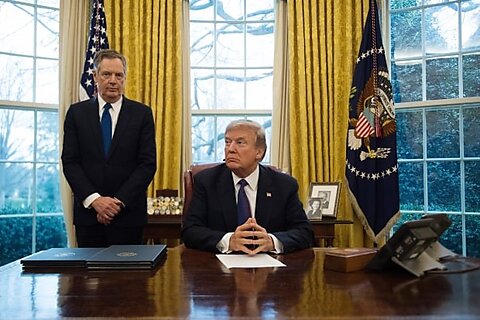

Attorney Robert Lighthizer, President Trump’s US Trade Representative in his first term, shares considerable responsibility for the stunning drop in manufacturing output and jobs soon after August 2018, when Trump’s first trade war began in earnest.
Trump’s first year, 2017, ended on a promising note with a bold reduction of the corporate tax rate from 35% to 21% and a minor trim of the top personal rate to 37%. The prospect of growth-friendly taxation was already anticipated in the last quarter of 2017, with a 4.6% rate of GDP growth. In 2018, unfortunately, Trump’s attention shifted to nasty, unpredictable tariffs, which had a paralyzing effect on business plans and world investors.
US GDP growth gradually slowed to 3.3% in the first quarter of 2018, 2.1% in the second, 2.5% in the third, and 0.6% in the fourth.
The S&P 500 stock index fell from 2789.8 in January 2018 to 2567.3 by December, with most of that loss in the last quarter.
Meanwhile, USTR Lighthizer’s relatively painless recommended tariffs on washing machines and solar panels in late January escalated to a serious trade war by August.
By June 1, previously limited 25% tariffs on steel and 10% on aluminum had spread to include Canada, Mexico, and the EU. By July 6, a first phase of USTR tariffs on $34 billion of imports from China went into effect, with another $15 billion added on August 23. A Peterson Institute study found, “the new $50 billion list targets even more intermediate inputs—95 percent of the products hit are now intermediate inputs or capital equipment used largely by American-based companies dependent on imports from China.”
Figure 1 shows that year-to-year growth in manufacturing output fell steadily after September 2018 and was down nearly 4% by October 2019. Manufacturing employment began falling continually after August 2018, long before the COVID-19 scare of March 2020.
Figure 1

In 2018, President Trump first began raising tariffs only on a small number of specific goods, such as washing machines, steel, and aluminum. By August, however, Trump levied tariffs of up to 25% on entire countries—notably, China, the EU, Canada, and Mexico.
In his second term in 2025, by contrast, Trump imposed high tariffs on many manufactured goods and all countries.
As Figure 2 shows, US manufacturing accounted for 11% of GDP before this one-man war on trade began in 2018. By the second quarter of 2025, manufacturing had shrunk to 9.4% of GDP.
Figure 2

Despite Robert Lighthizer having had his hands all over the first-term contraction of US manufacturing output and jobs in late 2018, his fawning February 6 letter about Trump in the Wall Street Journal tries to rewrite their first trade war fiasco as a glorious victory for the shrinking US manufacturing companies and jobs:
“In his first term,” says Lighthizer, “[Trump] did everything possible to change the dynamic. He put tariffs on China, used the threat of tariffs to renegotiate all our major trading agreements, and stopped the counterproductive World Trade Organization dispute process. He also moved the country’s understanding of the problem and acceptance of tariffs as the remedy dramatically in his direction. Prior to the unprecedented Covid pandemic, the results of his presidency were faster economic growth, new manufacturing jobs, real wage increases [and] the beginning of reindustrialization… [emphasis added].”
The whole idea that Trump tariffs would “protect US manufacturing jobs” was all lies then, and it is all lies now.